AI DETRIMENTAL EFFECTS EXPLAINATION
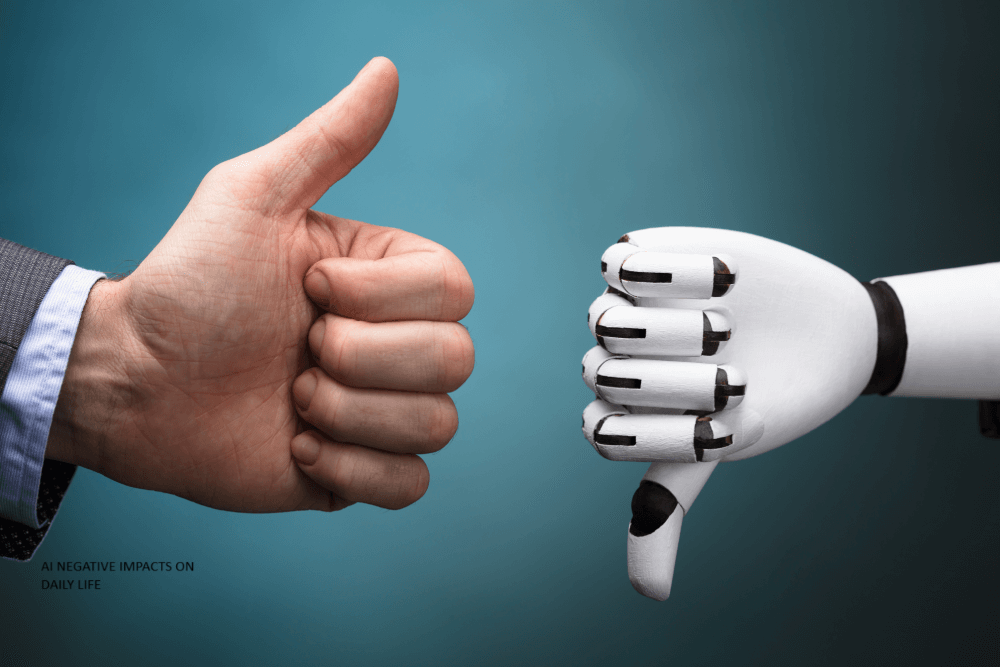
As AI becomes more integrated into our daily lives, its detrimental effects are becoming increasingly apparent. One major concern is the erosion of personal privacy.
With smart devices constantly collecting data, or our habits. AI can stifle our critical thinking and problem-solving skills. As AI systems provide us with instant answers and solutions, the need for independent thought decrease. People may rely too heavily on these technologies, leading to a generation that struggles with problem-solving and creativity.
This shift not only affects personal development but also stifles newness in various fields. It can lead to job losses as machines take over tasks. AI systems can also be biased, leading to unfair treatment. Over-reliance on AI can reduce human interaction and increase vulnerability to cyber threats. These challenges need to be addressed to ensure AI benefits society.
LIST OF DETRIMENTAL EFFECTS OF AI:
- Job Displacement
- Privacy Violations
- Weapons Automatization
- Fundamental threat
- Weak Human Influence
- Mental health effects
- Loss of human touch in communication
- Disinformation
- Social Comparison
Job displacement
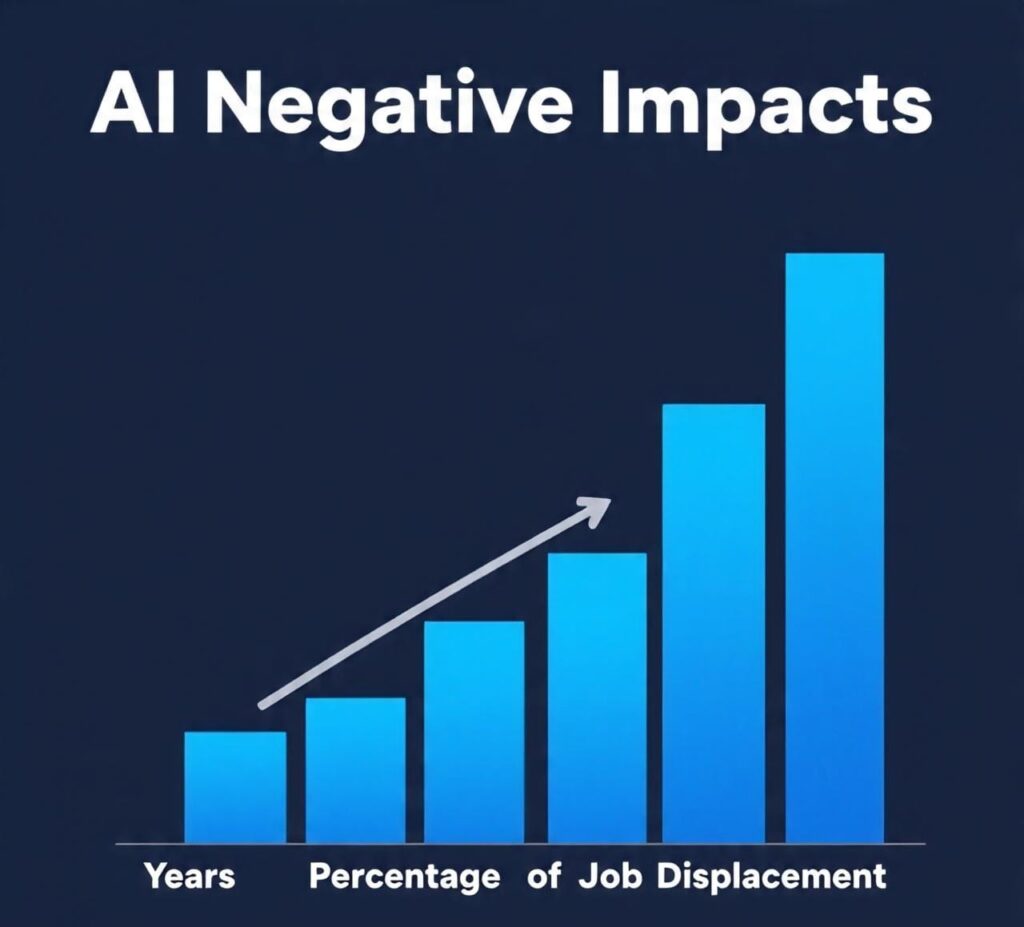
AI can bring many benefits, but it also has negative effects we need to think about. A big worry is job loss. As AI improves, machines and software can do tasks that people used to do.
This can cause many workers to lose their jobs. In factories, robots can build products faster and better than humans, resulting in fewer jobs for factory workers.
In offices, AI can take care of tasks like data entry and customer service. While this makes work more efficient, it puts many admin jobs at risk. Here is the list of jobs that disturb due to AI:
- Jan 2023: Google – 12,000 job cuts due to AI restructuring.
- Jan 2023: Microsoft – 10,000 layoffs related to AI and cloud investment.
- 2023: Amazon – 27,000 layoffs attributed to automation and AI.
- 2023: Meta – 21,000 jobs cut as part of AI restructuring.
- 2023: Salesforce – 8,000 layoffs linked to AI automation.
- Aug 2024: Intel – 15,000 jobs cut for AI chip restructuring.
- 2024: Dell – 6,650 layoffs due to AI strategy shift.
- 2025: TCS – 19,755 job cuts resulting from AI automation.
- 2025: Microsoft – 9,000 layoffs driven by AI investment.
- 2025: Salesforce – 4,000 jobs removed for AI customer service bots.
- 2025: Cisco – 4,250 layoffs focused on AI/cloud integration.
- Nov 2025: Over 110,000 global tech jobs lost to AI and automation.
- Mar 11, 2026: Atlassian – 1,600 employees cut (10% workforce) due to AI.
- Impact: 100,000+ call center jobs lost in India & Philippines from AI systems.
- Future Prediction: 1,000,000 office jobs expected lost by 2029 due to AI.
Job loss hits low-skilled workers the hardest, as they may struggle to find new jobs. They often lack the skills needed for other types of work, leading to unemployment and financial difficulties.
As AI keeps advancing, whole industries might change or vanish. This uncertainty can cause stress for workers and their families.
Privacy Violations
As artificial intelligence becomes more woven into the fabric of our daily lives, one of the most concerning issues is the potential for privacy violations. With smart devices listening in and algorithms tracking our every move.
On February 10, 2022, Clearview AI faced a hefty €20 million fine in Italy for misusing facial-recognition biometric data. Later, on October 19, 2022, France slapped Clearview AI with another €20 million penalty for illegally scraping facial images from the internet. In March 2023, ChatGPT experienced a data breach that exposed user data due to a system bug, raising serious concerns about data security.
In May 2023, Meta Platforms was fined $1.3 billion by the European Union for unlawfully transferring user data. Looking ahead, in December 2024, OpenAI is expected to face a €15 million fine in Italy for training its AI models using personal data without proper legal grounds. Furthermore, Clearview AI is set for a €30.5 million fine in the Netherlands for maintaining a biometric database without user consent.
In May 2025, Replika, developed by Luka Inc., will face a €5 million penalty in Italy due to user data misuse and inadequate age verification practices. Lastly, in November 2025, a case in Spain resulted in a €2,000 fine for creating AI-generated explicit images using minors’ faces, highlighting the ongoing risks associated with AI.
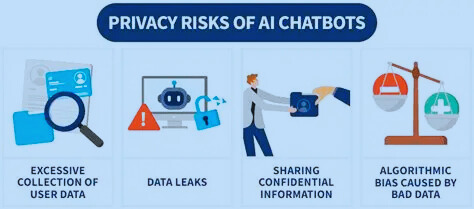
The very apps we rely on to make life easier often collect a wealth of data about us, from our shopping habits to our health metrics. This can lead to increased polarization and misunderstandings among individuals. AI can use machine-learning algorithms to assume what information you want to see on the internet and social media and then serve up information based on that assumption.
Weapons Automatization
In our everyday lives, the rapid integration of artificial intelligence has brought about conveniences we never thought possible. However, this same technology also a darker side that often goes unnoticed.
One of the most alarming negative impacts of AI is its role in weapons automatization. In March 2020, the Kargu-2 autonomous drone in Libya marked the first instance of an AI drone attacking humans without operator control. Earlier, in December 2008, the AI-assisted Sentry Tech system reportedly caused its first killing during Operation Cast Lead.
On July 7, 2016, Dallas Police used a Remotec ANDROS robot with explosives, marking the first lethal use of a police robot. Between 2023 and 2024, Israel’s AI targeting systems identified over 12,000 targets in Gaza, while the Ukraine war saw the deployment of around 2 million drones, including 10,000 AI-enabled ones. By May 2025, Ukraine introduced the Sky Sentinel AI turret, costing $150,000 each, to autonomously intercept drones. Most recently, in 2026, an AI-assisted military strike reportedly caused 83 deaths during an operation using AI intelligence tools.
Fundamental threats
As we continue to weave artificial intelligence into the fabric of our daily lives, I can’t help but feel a sense of unease about the fundamental threat it poses to our personal connections. Social media algorithms and chatbots may provide us with quick responses and selected content but they often replace genuine human interaction with hollow exchanges
I’ve noticed this in my own life, where conversations with friends sometimes feel like a series of programmed replies rather than authentic discussions. The ease of texting has led to a decline in face-to-face meetings, leaving us feeling more isolated even when we’re virtually connected.
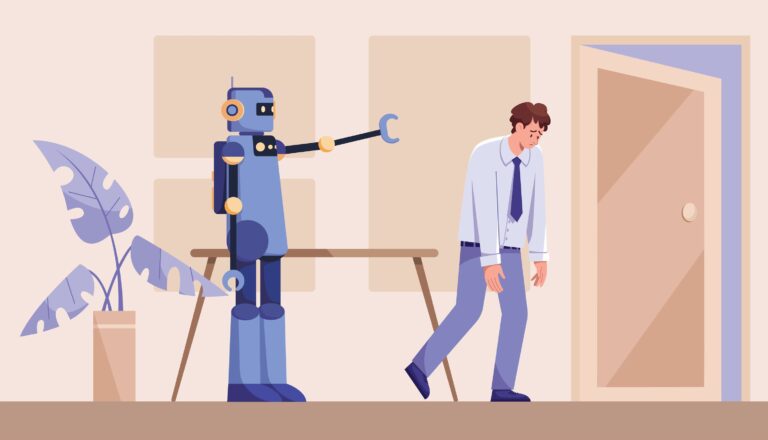
Moreover, the rise of AI tools and technologies in workplaces has introduced an unsettling uncertainty about job security. Many industries are rapidly adopting computerization leading to fears of unemployment for countless workers.
I’ve seen friends who once succeed in their careers suddenly struggling with anxiety over their futures, as their roles become increasingly susceptible to machines. This shift not only affects individual livelihoods but also diminishes the sense of community that comes from shared work experiences.
Weak Human Influence
As artificial intelligence continues to weave itself into the fabric of our daily lives, the subtle yet profound impacts on our human experience are becoming increasingly apparent. One of the most concerning aspects is the weakening of human influence in decision-making processes.
With AI systems often making choices for us be it in shopping, healthcare, or even relationships we risk losing the essence of our own agency. This trust on algorithms can lead to a merging of thought, where our preferences and desires are shaped by data-driven recommendations rather than genuine human connections.
Over-reliance on AI can erode human skills and abilities, making us less capable of performing tasks without technology. AI can lead to a decline in critical thinking skills, as humans may rely more heavily on technology to make decisions.
Mental health effects
As artificial intelligence becomes more integrated into our daily lives, its negative impacts are starting to surface, particularly regarding mental health effects. Many people find themselves overwhelmed by the constant notifications and information overload from AI-driven platforms.
This barrage can lead to heightened anxiety levels, as the pressure to stay connected and responsive grows. It’s as if we’re living in a race where our worth is measured by how quickly we respond to messages or updates, leaving little room for genuine human connection.

The impact of AI on mental health has raised serious concerns in recent years. In October 2021, a Facebook report revealed that 32% of teenage girls felt that Instagram worsened their body-image issues. Fast forward to 2023, a global study showed that 60% of users believed that AI-driven social media algorithms increased their anxiety and stress.
In March 2023, a data exposure bug in ChatGPT made thousands of users’ chat titles visible, leading to privacy-related stress. By 2024, the World Health Organization reported that about 970 million people, or 1 in 8, were living with mental health disorders, with digital technology and AI systems being contributing factors.
A study in 2025 found that 40% of heavy users of AI chatbots reported feeling lonelier and more isolated. Moreover, workplace AI monitoring tools affected employees’ mental well-being, with 35% reporting higher stress due to constant surveillance. These findings highlight the need for awareness and intervention as technology advances.
Loss of human touch in communication
The rise of AI in our daily lives very helpful for us but it also comes with a significant downside: the loss of human touch in communication. As we increasingly rely on chatbots and automated responses, the warmth and empathy that come from genuine human interactions often ignored. .
Imagine having a heartfelt conversation with a friend, only to realize that you were actually chatting with an AI. This shift can create feelings of isolation, as people may find themselves longing for real connections that technology simply cannot replicate
Moreover, the pervasive use of AI tools in social media and messaging apps can lead to misunderstandings and misinterpretations. Algorithms often prioritize brevity and clarity, which cannot convey the language of feelings and emotions. When a message is reduced to a few words or emojis, important context may be lost, leaving individuals feeling misunderstood or undervalued.
Disinformation
One of the most concerning negative impacts of AI on daily life is the rise of disinformation. With algorithms designed to prioritize engagement over truth, social media platforms often amplify false narratives, misleading news, and conspiracy theories. This flood of misinformation can wrong our perception, leading to confusion and mistrust in reliable sources. Imagine scrolling through your feed and coming across a sensational headline that plays on your emotions before you know it, you’re sharing it with friends, unknowingly spreading this, that can influence opinions and behaviors.
- 2022: 25 million users impacted by deepfake misinformation.
- 2023: 250% rise in fake political videos.
- 2023: Over 250,000 deepfake videos identified on social media.
- Nov 2023: Synthetic media constituted 22% of AI incident peak.
- 2024: 26% of internet users faced deepfake scams.
- 2024: 107 instances of AI-manipulated misinformation reported.
- 2025: Predicted 8 million deepfakes will exist online.
Additionally Smart devices collect vast amounts of personal data to tailor experiences, but this often comes at the cost of our security. As algorithms learn more about our preferences, they can create detailed profiles that not only invade our privacy but also expose us to targeted scams and manipulative advertising, Therefore, we choose creativity and avoid overusing AI.
Social Comparison
In our tech-driven world, the rise of AI has brought some unexpected negative impacts on daily life, particularly through social comparison. As algorithms curate our online experiences, they often highlight the best moments of others’ lives, leading to an unrealistic benchmark for happiness and success.
This constant exposure can create a toxic cycle where individuals measure their worth against curated feeds, feeling inadequate and disconnected from their own realities. The pressure to keep up can be overwhelming, making it difficult to appreciate one’s unique journey.
In October 2021, 32% of teenage girls reported feeling worse about their bodies. By 2022, the number of users who felt negatively about themselves when comparing to others rose to 59%. In 2023, 45% of teenagers felt their self-esteem was lower than before.
This trend has continued, as by 2024, 14% of adolescents were facing mental health problems. Finally, in 2025, 37% of users showed symptoms of depression. These numbers highlight a growing concern about how social media affects the mental well-being of young people.
Moreover, AI-driven recommendations can trap users in echo chambers, amplifying feelings of isolation. When everyone seems to be living their best life while we struggle with our own challenges, it fosters a sense of loneliness that’s hard to shake off.
Conclusion:
while AI has brought many advancements to our daily lives, it also comes with several negative impacts that we cannot ignore. From the increasing dependence on technology to the potential loss of jobs, these issues affect our day-to-day experiences in significant ways. Moreover, privacy concerns and the spread of misinformation can create an environment of distrust and anxiety. It’s important for us to be aware of these challenges so we can find a balance between embracing technology and protecting our well-being. Let’s start a conversation about how we can use AI responsibly and make our lives better without losing what truly matters.
FAQ:
Is AI making us less creative?
Some argue that over-reliance on AI tools for writing or art can stifle human creativity by encouraging shortcuts instead of original thinking.
How can AI affect my job?
AI can automate tasks, which might lead to some jobs being replaced or changed. This can make it harder for people in certain roles to find work.
Does AI invade my privacy?
Yes, AI can collect and analyze personal data, sometimes without your consent. This can lead to concerns about who has access to your information and how it is used.
How does AI impact my mental health?
AI-driven apps and social media can create unrealistic expectations and comparisons, which may lead to anxiety, depression, or low self-esteem.