Is GPT-Zero Accurate?
In a world where artificial intelligence is reshaping our understanding of creativity and originality, many are left wondering just how accurate tools like GPT-Zero really are. This article delves into the nuances of GPT-Zero, exploring its efficacy in distinguishing between human and machine-generated text. By the end, you’ll have a clearer understanding of its potential limitations and strengths, helping you navigate the evolving landscape of AI-generated content.
What Does Official Data Say About GPT-Zero’s Accuracy?
Official data from GPTZero suggests impressive accuracy — around 99% when identifying clear AI-generated text and about 96-97% for mixed human-AI content. The tool also has a strong track record for keeping false positives low, rarely mistaking human writing for AI.
However, independent studies show a different story. Evaluations in real-world conditions report accuracy rates closer to 80-92%, which is significantly lower than GPTZero’s official claims.
The tool struggles more with edited, paraphrased, short, or mixed texts. In these cases, it often misses AI-generated content, leading to false negatives.
In summary, while GPTZero shines in controlled tests and avoids mislabeling human work, its real-world performance is notably less reliable. It serves best as an initial screening tool rather than a definitive answer.
What Are the Common Myths About GPT-Zero’s Accuracy?
Many people think that GPT-Zero’s True Accuracy is flawless in every situation. However, there are several myths that can cloud our understanding of how this tool really works, especially in complex writing settings. In the following sections, we will take a closer look at some of the most common myths surrounding GPT-Zero and break down where they come from and how accurate they really are.
Myth 1: GPT-Zero Works Equally Well on All Subjects and Lengths
Many users assume that GPT-Zero’s accuracy is uniform across various topics and document lengths. In reality, its performance can vary significantly based on the complexity and specificity of the subject matter. Shorter texts may yield different results compared to longer, more complex documents.
Myth 2: One GPT-Zero Result Is Enough to Make a Decision
Another prevalent misconception is that a single GPT-Zero result can inform a definitive decision. However, relying on just one output can be misleading. It’s essential to consider multiple analyses and context to arrive at a well-rounded conclusion.
Myth 3: GPT-Zero Works the Same for All Languages
Users often believe that GPT-Zero provides consistent accuracy across different languages. This assumption overlooks the nuances and variations in linguistic structure that can impact the model’s reliability. Some languages may pose challenges that affect the software’s performance.
Myth 4: GPT-Zero Is the Same as Other AI Models
Lastly, many people conflate GPT-Zero with other AI models, failing to understand its unique capabilities and limitations. While it shares some traits with other AI tools, its specific design focuses on detecting AI-generated content, making it distinct in its approach and function.
My thoughts on these myths
- Myths about GPT-Zero’s accuracy stem from misunderstandings of AI detection tools.
- Belief in equal efficacy across subjects and text lengths ignores linguistic pattern variations.
- Short or technical texts struggle for reliable analysis due to insufficient data.
- Longer texts may mix writing styles, affecting detection accuracy.
- A single GPT-Zero output oversimplifies the decision-making process.
- One result cannot account for revisions, edits, or contexts.
- GPT-Zero’s performance is inconsistent across languages, primarily optimized for English.
- Misconceptions confuse GPT-Zero’s analysis function with generative AI capabilities.
- Automated detection tools require human judgment and ethical considerations.
How Can We Assess GPT-Zero’s True Accuracy in Real-World Use?
In this section, I want to share my personal experience with GPT-Zero while I was working at aicognitivezone.com. I explored how well this tool analyzes various types of content, including AI-generated blogs and edited drafts. My hands-on experience provided valuable insights into the actual accuracy of GPT-Zero.
To start, we asked ChatGPT to write a paragraph about “the role of artificial intelligence in education.” This exercise was fascinating and shed light on how AI can contribute to learning.
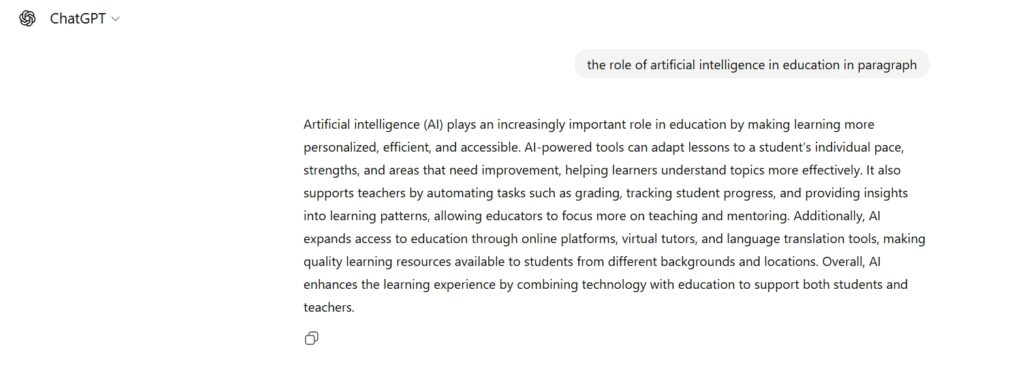
Here’s the scan from GPT Zero.
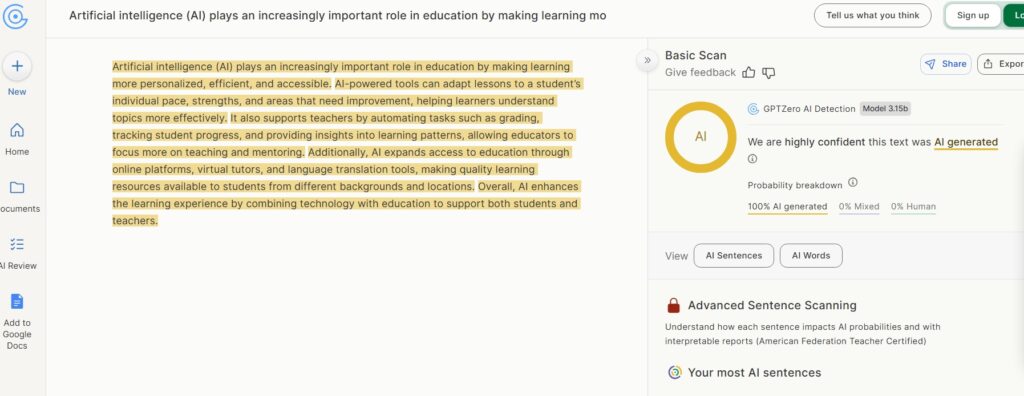
Summary of Findings:
GPTZero showed strong confidence when analyzing a text. It reported being 100% certain that the document was created by AI and found no signs of human authorship.
It’s important to think about GPTZero’s accuracy. Like any tool, it can make mistakes and may incorrectly tag human-written content as AI, which is known as false positives.
Compared to ZeroGPT, GPTZero has fewer false positives, meaning it’s less likely to wrongly label human text as AI. However, it may miss some AI-generated content, known as false negatives. For everyday writing, ZeroGPT can detect AI with 95% accuracy, while GPTZero reaches 84%. The downside of ZeroGPT is that it often mislabels human content as AI.
Introduction to GPT-Zero Misclassification
Understanding why GPT-Zero misclassifies content is crucial for improving its accuracy. Several factors contribute to these misclassifications.
Ambiguity in Language
One primary reason is the inherent ambiguity in human language. Words and phrases can have multiple meanings, leading to confusion in classification.
Contextual Nuances
Additionally, the lack of contextual understanding poses a challenge. GPT-Zero may fail to grasp the subtleties of context, resulting in incorrect classifications.
Variability in Writing Styles
The variability of writing styles among different authors can also be a significant factor. Each writer has unique quirks and tones, making it difficult for GPT-Zero to pinpoint the correct classification consistently.
Insufficient Training Data
Furthermore, limited or biased training data can skew results. If GPT-Zero is not exposed to a diverse range of examples, it may misinterpret certain content.
How Does GPT-Zero’s Accuracy Compare to Other AI Detectors?
When it comes to selecting a plagiarism detection tool, it’s important to know which one fits your needs best.
- GPTZero is great for quick screenings. It offers a medium accuracy level, making it useful for initial assessments but not suitable for in-depth checks.
- Turnitin is widely recognized in academic circles for its high accuracy. It’s perfect for ensuring academic integrity in research papers and essays.
- For those focused on Web and SEO content, Originality.ai shines with high accuracy. It’s an excellent choice for writers and marketers looking to maintain originality online.
- Copyleaks handles mixed content well, also boasting high accuracy. It’s versatile enough for both academic and casual writings.
- If you’re working on marketing text, Writer.com provides medium to high accuracy. It’s tailored for creating compelling advertising content.
- Sapling is effective for short professional texts, offering medium accuracy. It’s good for emails and brief reports.
- Crossplag is suited for research writing and comes with medium to high accuracy. It helps ensure that scholarly work remains original.
Finally, ZeroGPT is better for casual checks, with low to medium accuracy. It’s suitable for informal content but not for serious academic use.
Choosing the right tool depends on your specific needs and the type of content you’re working with.
How Accurate Is GPTZero at Distinguishing ChatGPT from Human Texts?
In 2023, researchers undertook a rigorous study to assess GPTZero’s ability to differentiate between AI-generated and human-written text. Employing a test-negative case-control study design, the researchers aimed for reliable results, mirroring techniques often used in diagnostic accuracy research.
Sample Selection
The analysis comprised 50 text samples, split into 20 AI-generated samples via ChatGPT and 30 human-written texts. This diverse selection enabled a comprehensive evaluation of GPTZero’s classification capabilities.
AI Detection Performance
Out of the 20 AI-generated samples, GPTZero correctly identified 13 as machine-produced. However, it misclassified 7 texts as human-written, yielding a sensitivity rate of 65%. This indicates that the tool successfully detected about two-thirds of the AI content.
Human Detection Accuracy
From the 30 human-written samples, GPTZero accurately labeled 27 as human-authored. Nevertheless, it incorrectly flagged 3 texts as AI, resulting in a specificity rate of 90%. This suggests that GPTZero is effective in minimizing false accusations against human writers.
Overall Effectiveness
Combining both classifications, GPTZero achieved an overall accuracy of 80%. In practical terms, this means the tool provided correct verdicts 4 out of 5 times, with a misclassification occurring once in every five samples. (Source)
Conclusion
GPT-Zero offers a useful way to check if text is real or generated by AI, but its accuracy is still debated. Many studies show it can spot some patterns of AI content. However, it is not perfect and has limitations, especially in complex situations. Users should critically assess its results and use human judgment when needed. As technology changes, we must also improve our evaluation methods. Staying informed and adaptable is key to handling this evolving landscape.
FAQs
What is GPT-Zero?
Answer: GPT-Zero is an AI tool designed to detect whether a piece of text has been generated by an AI model, such as OpenAI’s GPT-3 or similar systems.
How does GPT-Zero determine text authenticity?
Answer: It analyzes various linguistic patterns, sentence structures, and statistical features in the text to assess its likelihood of being AI-generated.
Is GPT-Zero 100% accurate?
Answer: No, while GPT-Zero aims for high accuracy, no detection tool is infallible; results should be interpreted with caution.
Can GPT-Zero differentiate between human and AI writing styles?
Answer: Yes, it can identify certain markers typical of AI-generated content, but it may struggle with nuanced or creative human writing.
What factors influence GPT-Zero’s accuracy?
Answer: Factors include the complexity of the text, the training data used by GPT-Zero, and how closely the AI-generated text resembles natural human language.
How can I improve the accuracy of GPT-Zero?
Answer: Providing clearer context and using well-defined parameters for the text sample can help enhance the tool’s accuracy in assessment.
What are the limitations of GPT-Zero?
Answer: Limitations include difficulty with subtle human nuances, potential biases in its training data, and evolving AI technologies that may outpace detection capabilities.