Is ZeroGPT Accurate?
As we increasingly rely on tools like ZeroGPT to help with our writing, it’s important to check how accurate they really are. In this article, we’ll take a closer look at how ZeroGPT works, its strengths and weaknesses, and why this is important for anyone using it, whether for personal or professional tasks. By the end, you’ll have a better understanding of when you can trust this tool and when it might need a second look.
What Is ZeroGPT?
ZeroGPT is a tool designed to detect text generated by AI language models. With the rise of artificial intelligence, understanding whether content is created by a human or a machine has become more important. ZeroGPT aims to help users and educators identify AI-generated text, ensuring academic integrity and promoting authentic writing. Its ability to upload documents, track percentage scores, and provide more specific detection labels.
The idea for ZeroGPT emerged as AI technology evolved rapidly. As AI tools became more accessible like ChatGPT, so did the potential for misuse, especially in academic settings. Developers recognized the need for a reliable detection method to address concerns around plagiarism and authenticity.
Started in 2022 by Olive Clinton, ZeroGPT has gained attention from students, teachers, and content creators alike. It uses advanced algorithms to analyze various patterns in text, helping users distinguish between human and AI writing. As technology continues to advance, tools like ZeroGPT play a crucial role in maintaining trust in written communication.
Why Use ZeroGPT?
There are various reasons individuals turn to AI detection tools, with ZeroGPT often being among the initial options they explore.
Here are the most prevalent scenarios I’ve encountered.
- The tool identifies if writing originates from AI models like ChatGPT or GPT-4.
- Useful for students and teachers to check originality in assignments and papers.
- Assists bloggers and writers in ensuring their content is human-written.
- User-friendly interface allows for easy text input and quick results.
- Highlights AI-generated sentences for targeted revisions.
- Supports text analysis in multiple languages, enhancing its versatility.
- Basic detection services are free, promoting content integrity for all users.
Ease of use is important, but accuracy is key to effectiveness. Accurate information and processes can greatly affect results. A tool may be easy to use, but if it isn’t reliable, its benefits are limited. The path from being user-friendly to effective depends on balancing ease of use and accuracy, with accuracy being essential for real success.
Is ZeroGPT Accurate?
ZeroGPT is a tool designed to help people understand and create text more effectively. Many users find it quite accurate for generating ideas and providing information. It can quickly produce content based on prompts, making it a handy resource for writers and students alike. However, like any tool, it’s important to check the results, as it may not always be perfect.
ZeroGPT’s Claimed Accuracy vs. Real-World Results
ZeroGPT promotes itself as having high accuracy, claiming up to 98% in its advertisements. This is largely due to its proprietary DeepAnalyse™ algorithms, designed to detect specific AI-driven language patterns.
However, independent evaluations tell a different story. In controlled settings, where texts are generated by AI without any edits, ZeroGPT performs well and can accurately identify AI-written content.
In real-world situations, though, the accuracy drops significantly. Tests show that it can vary from about 35% to 80%, depending on the type of content and how much it has been edited.
In summary, while ZeroGPT claims an impressive accuracy rate of 98%, actual results often fall short when dealing with diverse texts.
Accuracy on Raw vs. Edited Content
Raw AI-Generated Text
ZeroGPT is quite effective at identifying unedited content produced by AI models like ChatGPT, Claude, or Gemini. It often flags such text as being nearly 100% AI-generated. This means that if you use text straight from these AI tools, ZeroGPT will likely catch it.
Bright SEO Tools
However, when the AI-generated text is paraphrased using tools like QuillBot, ZeroGPT’s detection accuracy drops significantly. In many cases, it can fall to around 22% to 71%. This shows that rewritten text can be much harder for the tool to recognize.
AI Jumble
Additionally, if the AI content is lightly edited or “humanized,” it often escapes detection altogether. These slight changes can result in a low probability of being flagged as AI-generated.
In summary, editing or rewriting AI text can significantly reduce ZeroGPT’s ability to detect it as AI-generated content. So, if you want to make your text less likely to be flagged, consider making some edits or paraphrasing!
False Positives and False Negatives
False Positives
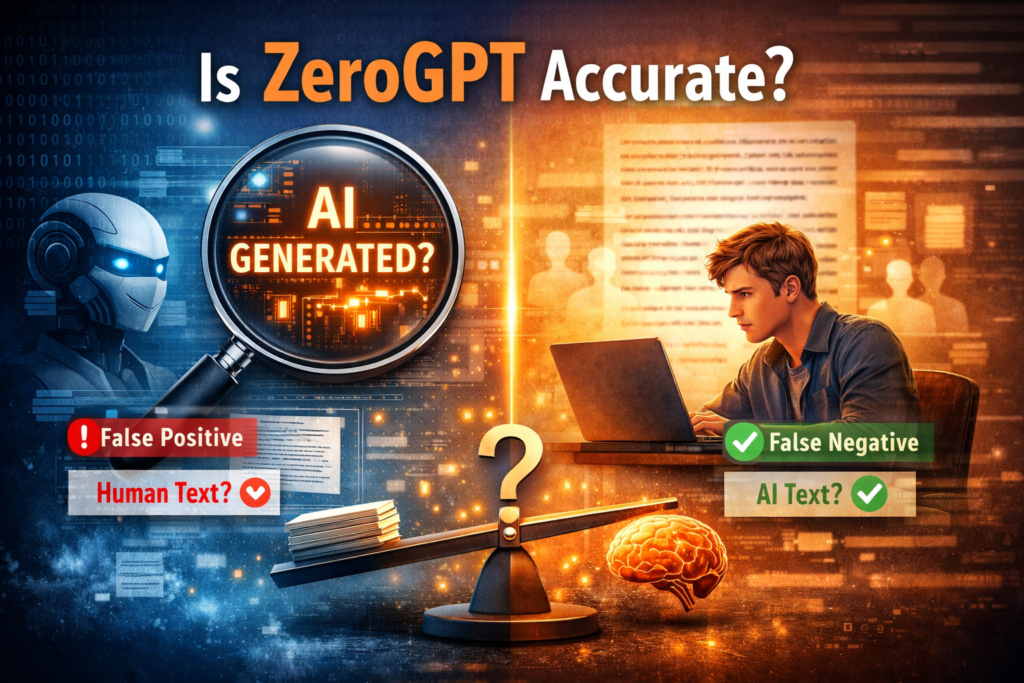
One big issue with AI detection tools is false positives, where human-written text is mistakenly flagged as AI-generated.
Tests have shown that especially well-structured or formal writing often gets marked as AI by these tools. For instance, some independent reviews highlighted how ZeroGPT assigned high AI scores to content created entirely by humans.
False Negatives
On the flip side, there are false negatives, where AI-generated text isn’t recognized as AI. Even text produced by advanced models, without any edits, sometimes doesn’t get flagged.
Studies have also found that when using techniques like paraphrasing, ZeroGPT might miss identifying AI-written content altogether.
In summary, ZeroGPT can both falsely identify human text as AI and fail to catch AI-generated text. This means it’s not a reliable tool for determining the true authorship of a piece.
Variation by Content Type and Length
When it comes to detecting AI-generated text, accuracy isn’t the same across different lengths and types of writing.
Longer texts tend to produce better results. The clearer and more detailed the writing is, the more effective the detection becomes. Tools like Hastewire show improved accuracy with these longer pieces.
On the other hand, highly technical or very creative writing can confuse detection tools. For instance, ZeroGPT Plus often struggles with this type of content.
Additionally, when you mix human and AI writing, results may vary. Some Tools find it challenging to detect such mixed content accurately, providing only moderate results.
In summary, detection tools work best with longer, well-structured text, while they struggle with brief or stylistically diverse writing.
Overall Accuracy Verdict
ZeroGPT is generally considered to be quite accurate in generating text. Many users find that it produces relevant and coherent responses based on the prompts given. Overall, the accuracy can vary depending on the complexity of the request, but for most everyday tasks, it delivers reliable information and ideas. Whether you’re looking for help with writing or just want to have a conversation, ZeroGPT does a good job of understanding what you need.
ZeroGPT vs. Other AI Detectors
When comparing ZeroGPT to other AI detectors, a few key factors stand out.
AI Detection Accuracy
When it comes to detecting AI-generated content, various tools offer different levels of accuracy. ZeroGPT boasts an impressive accuracy rate of around 87% to 90%. It’s designed to identify subtle nuances in text that may indicate AI involvement.
In contrast, GPTZero claims a remarkable accuracy of approximately 99%. This tool utilizes advanced algorithms to differentiate between human and AI writing, making it a top choice for educators and content creators.
Turnitin follows closely behind with a solid 95% accuracy. Traditionally known for plagiarism detection, it has adapted its technology to address AI-generated content effectively.
Copyleaks also provides reliable results, achieving about 90% accuracy in detection. Its user-friendly interface makes it accessible for users across various platforms.
Lastly, other detectors like Originality.ai tend to have a variable accuracy range of 75% to 85%. While they may not be as precise as their counterparts, they still offer valuable insights in identifying AI-generated text.
False Positive Rate (human labeled as AI)
When assessing AI detection tools, it’s crucial to consider their false positive rates, which indicate how often human-written content is incorrectly labeled as AI-generated.
ZeroGPT has a false positive rate of approximately 5-8%. This means that in some cases, genuinely human-written text may be misidentified as produced by an AI.
GPTZero demonstrates a lower false positive rate, ranging from 1-3%. This makes it a more reliable choice for users who need accuracy in differentiating between human and AI text.
Turnitin AI Detection features a false positive rate of 4-6%. As a widely used tool in academic settings, its accuracy is essential for maintaining academic integrity.
Copyleaks shows a false positive rate between 3-7%, which also presents a reasonable balance for detecting AI content without significant errors.
In contrast, other detectors like Originality.ai exhibit a higher false positive rate of over 10%. This can lead to more frequent inaccuracies and potential issues for users relying on its results.
Overall, when selecting an AI detection tool, those with lower false positive rates are generally favored for their precision and reliability.
False Negative Rate (AI missed as human)
ZeroGPT has a moderate to high false negative rate, meaning it sometimes fails to recognize AI-generated content as artificial. This can lead to some AI texts being overlooked, which might be concerning for users seeking reliable detection.
In contrast, GPTZero boasts a low false negative rate. It effectively identifies AI-generated content, making it a solid choice for educators and content reviewers. This reliability helps ensure the authenticity of written work.
Turnitin’s AI detection tool has a moderate false negative rate. While it does a decent job of catching AI-generated text, there is still a chance that some content may slip through undetected. Users should be vigilant.
Copyleaks also shows a moderate false negative rate. This tool is designed to catch AI writing effectively, but similar to Turnitin, it can occasionally miss some AI-generated text. Regular updates help improve its accuracy.
When looking at other detectors like Originality.ai, the false negative rate tends to be high. This means that many AI-generated texts may not be flagged, making such tools less reliable for users needing stringent detection.
In summary, choosing an AI detection tool depends on your specific needs. If low false negatives are crucial, tools like GPTZero may be your best bet.
Performance on Edited/Paraphrased AI Text
ZeroGPT has a detection rate of about 78%. This means it identifies less than eight out of ten instances of altered AI-generated content. It’s a useful tool but may miss some subtleties.
GPTZero performs even better, boasting a remarkable 96.5% accuracy. This high percentage indicates it’s highly effective at spotting even cleverly modified text.
Turnitin AI Detection follows closely with an 85% detection rate. This tool is well-known in academic circles for checking originality and can catch many types of AI-related writing.
Copyleaks reports an 88% success rate. It’s another strong option for detecting AI-generated text, especially in educational settings.
Finally, other tools like Originality.ai are slightly less effective, with around 70% accuracy. While useful, they may require users to be more vigilant.
In summary, if you’re looking for reliability in spotting edited AI text, GPTZero and Copyleaks are among the top choices, while ZeroGPT and Originality.ai may serve as supplementary tools.
Performance on Short/Creative Text
ZeroGPT has a low to medium performance when evaluating short or creative texts. It may struggle to pinpoint subtle nuances in writing style, making it less reliable for artistic pieces.
GPTZero, on the other hand, offers medium performance. It’s somewhat effective at identifying AI-generated content, but still has its limitations, especially with creative expressions.
Turnitin is known for its strong plagiarism detection capabilities. It provides medium performance for creative texts, making it a preferred choice for academic integrity.
Copyleaks ranks higher with a medium to high performance in detecting both small and longer texts. Its advanced algorithms help it identify potential AI influence effectively.
Lastly, other detectors like Originality.ai also aim for accuracy, with a low performance rating for creative content. While useful for standard checks, they may fall short in recognizing subtleties in unique writing.
In summary, each tool has strengths and weaknesses, making it essential to choose based on your specific needs.
Ease of Access (Cost / Free Tier)
ZeroGPT is an accessible tool that offers both free and low-cost options. It helps users quickly identify AI-generated content without needing a subscription, making it a great choice for individuals and small businesses.
GPTZero is another user-friendly option available for free, with additional paid features. Created with educators in mind, it provides insights into whether text is written by a human or an AI.
Turnitin, on the other hand, typically requires institutions to pay for its services. It’s widely used in schools and universities to check for plagiarism, but it also has features for detecting AI content.
Copyleaks offers both free and paid plans, catering to different needs. Its features are particularly useful for businesses and educators who want a comprehensive analysis of written content.
Finally, there are other detectors like Originality.ai, which mainly operate on a paid basis. These tools are designed for professionals looking for detailed checks to ensure originality in their writing.
Overall, while some tools are free or low-cost, others tend to have a price tag that may be more suitable for institutions or larger organizations.
Integration (e.g., LMS, Turnitin SaaS)
ZeroGPT and GPTZero have limited integration options, meaning they can’t easily connect with other platforms like learning management systems (LMS). This might make it harder for users to streamline their workflow.
Turnitin, on the other hand, offers integrated solutions that work well within academic settings. Educators can easily access its features through its established software, making it a popular choice in schools and universities.
Copyleaks provides similar integration capabilities and is designed to detect plagiarism as well as AI-generated content. This makes it a versatile tool for various content checks.
Other detectors, like Originality.ai, can vary in their integration features. Some may have more options for connecting with different platforms, while others may not.
In summary, if you’re looking for seamless integrations, tools like Turnitin and Copyleaks may be your best bet. Meanwhile, ZeroGPT and GPTZero might work better for those with simpler needs, as they offer basic functionality without complex integration.
Best For Different Needs and Preferences
Best for quick general checks, ZeroGPT offers a fast, user-friendly interface. It can quickly identify AI-generated text, making it suitable for everyday checks. However, it’s not ideal for high-stakes grading or serious policy enforcement.
Balanced accuracy is the strong suit of GPTZero. It’s designed to be reliable for various applications, but it may struggle with very short creative posts. Its strengths lie in more extended texts where context plays a vital role.
Turnitin is predominantly used by academic institutions. It excels at identifying plagiarism and ensuring integrity in academic work. Unfortunately, it’s not the best choice for casual use or non-academic writings.
Copyleaks specializes in detecting paraphrased content. It’s useful for both personal and professional levels, providing insights and checks for content originality. Still, keep in mind that it may not be as effective for very short texts.
There are various other options available like Originality.ai, catering to casual use and content checks. These tools can help ensure the originality of your writing yet may fall short in high-accuracy needs.
Conclusion
ZeroGPT has shown promising results in generating text, but accuracy can vary depending on the context and the complexity of the topic. While it can provide helpful information, users should always double-check facts and be cautious with sensitive subjects. It’s important to treat its outputs as a starting point rather than absolute truth. Overall, ZeroGPT is a useful tool, but like any technology, it’s best when used with care and critical thinking.